
About the project
Wediscit
An accessible underwater exploration ecosystem, where people, experts, data and intelligent robots learn from each other.
The Problem
Most of our planet is covered by water, but for most people the underwater world is still almost impossible to explore.
Today, underwater archaeology and cultural heritage research are mainly connected with professional divers, archaeologists, research teams and expensive equipment. This means that people who are simply curious about what is hidden beneath seas and lakes usually have no real way to take part.
We believe this should change.
There are millions of people who love history, nature, seas, lakes, exploration and discovery. They may not be professional divers or archaeologists, but they are interested in learning more about what is underneath the water and about the stories hidden there.
The Solution
This is where the idea of Wediscit began. Our goal is to make underwater exploration more affordable, simple and accessible, so that more people can take part in discovering and documenting underwater cultural heritage.
But we quickly realised that building an underwater robot was not enough. The bigger idea became to create a complete ecosystem.
The first part is the underwater robot, which helps people explore and record what they see beneath the surface.
The second part is the Wediscit Explorer Platform — a digital community for underwater cultural heritage. We imagine it as something like a modern-day Instagram for underwater exploration, but with a much deeper purpose. Users can upload photos and videos from underwater drones, create 3D visuals, share discoveries, collect information from different locations, rate interesting findings and connect with archaeologists who can provide professional feedback.
As more people contribute, the platform can grow into a large global database of underwater observations. In the future, the collected images and videos could also help train underwater robots to understand underwater environments better. The more useful data the system receives, the smarter future robots could become.
Our long-term vision is to move toward underwater robots that can complete more of an exploration mission independently — similar to the idea of a driverless taxi, where the user chooses the destination or task and the machine handles more of the journey itself.
How We Solve Our Problem
Our major problem
In our first tests the robot was not diving properly: it stayed on the surface. After researching the cause we understood the rule behind it — if the weight of the submarine is lower than the amount of water its volume pushes aside, it floats. So to fix it we had to increase the weight of the submarine until it was greater than what its volume produces.
By our calculations the hull’s volume is 1876 cm³, about 1.9 L. That means the robot needs to weigh more than 1.9 kg just to go down, and to dive fast even under seawater we decided our target weight should be 2.5 kg. Right now it weighs only 1.4 kg, so in our case the volume of the submarine is still bigger than its weight.
- The symptom: in the first tests the robot stayed on the surface instead of diving.
- The rule: it floats while its weight is lower than the water its volume displaces.
- The numbers: hull volume 1876 cm³ (about 1.9 L), so it must weigh more than 1.9 kg.
- The target: 2.5 kg, so it dives correctly and fast even under seawater.
- Where we are: 1.4 kg today — the volume is still bigger than the weight.
One of the first real problems we met on the robot was the way it sits in the water: we wanted the front of the submarine to be slightly deeper than the back, so the camera looks down at the seabed instead of straight ahead.
Our answer is a 3D-printed weight gripper that sits along the bottom of the submarine. Each of its compartments holds 0.4 kg of weight, so the ballast is fixed exactly where we need it, and with the gripper installed the nose of the submarine drops slightly below the tail — the exact attitude we were after.
We learned about this problem late. We had time to design the solution and produce a 3D model of it, but not to print it in carbon-reinforced PC and mount it on the submarine’s hull.
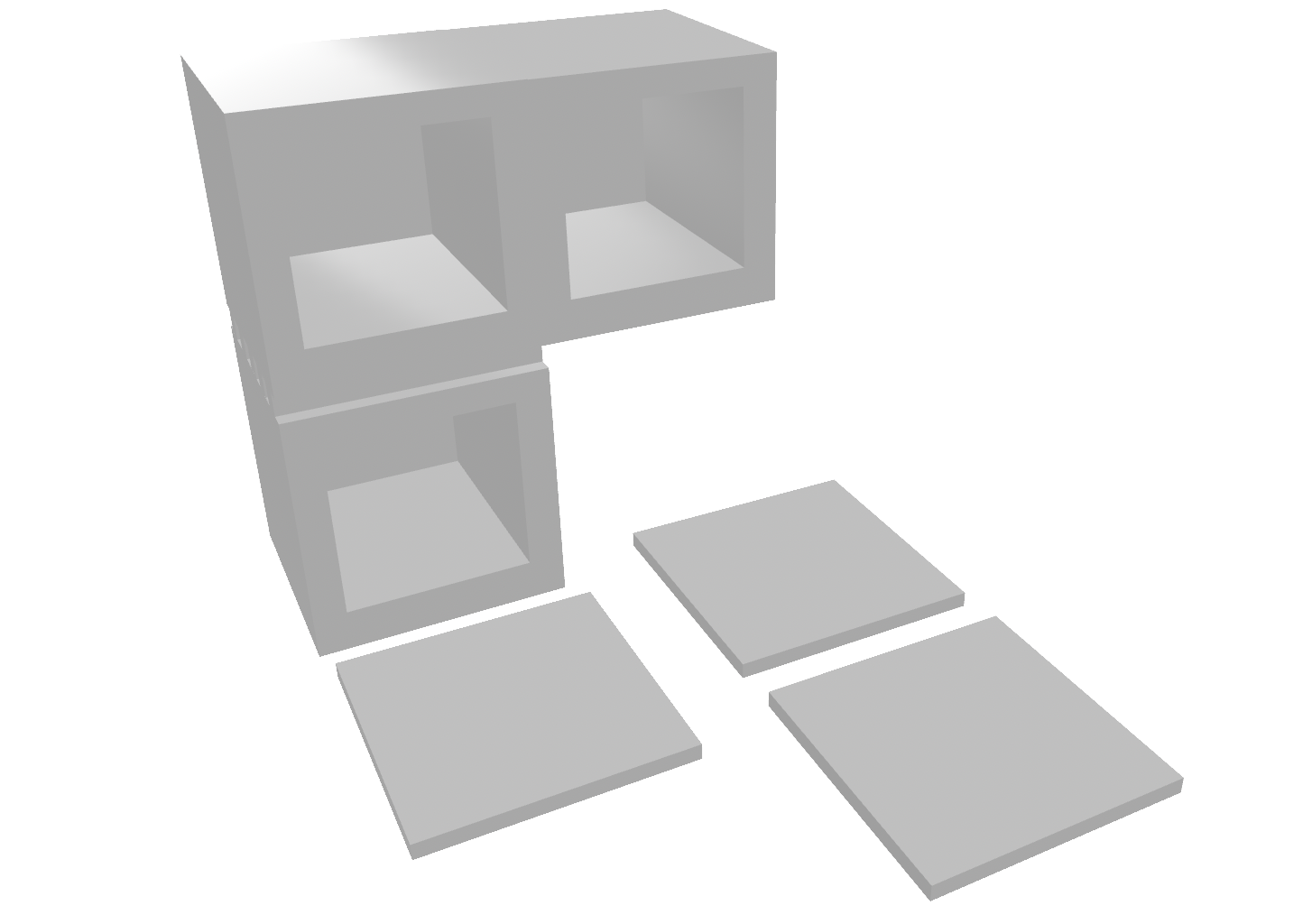
- What it is: a 3D weight gripper mounted under the submarine.
- Ballast: 0.4 kg of weight in each compartment.
- Effect: the front of the submarine rides slightly more underwater than the back.
- Status today: the 3D model exists; the carbon-reinforced PC print and mounting on the hull are still ahead of us.
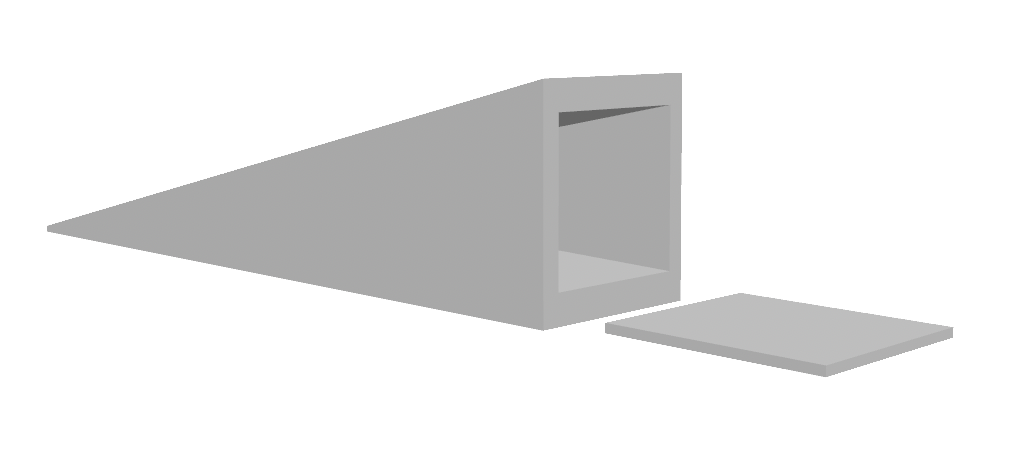
- Next step: a more compact version two, because the first design is too large.
Working on it also showed us a major weakness in the design: its size. That is why we decided to build a second version of the weight gripper that does the same job in a much more compact form.
The Research and Project Evolution
Before building Wediscit, we wanted to understand the problem properly. We did not want to create another underwater robot just because it looked interesting. We wanted to know what already exists, what archaeologists actually need, what ordinary people are missing and where our project could bring something new.
Our research changed the project several times. In the beginning our idea was much simpler: an interactive digital museum of underwater cultural heritage. After researching underwater archaeology and speaking with archaeologists, we understood that the bigger challenge was helping people discover, document, organise and learn about underwater cultural heritage in the first place.
Research with archaeologists
Underwater archaeology is not simply about finding an object and taking it out of the water. In many cases archaeologists prefer to document objects where they are found. Digital documentation, photography, photogrammetry, mapping and 3D reconstruction help researchers study a site without immediately removing objects from their environment.
We also studied UNESCO's approach, which treats preservation in situ — keeping heritage in its original location — as an important first option. This led us to think about Wediscit mainly as a tool for observation and documentation, not for collecting underwater objects.
Instead of asking “How can we show underwater artifacts?” we started asking “How can more people help discover and document what is underwater?”
Research into existing underwater robots
We researched professional underwater robotics companies and systems, including VideoRay, Saab Seaeye, Kongsberg Maritime, DeepOcean and Oceanos, as well as platforms such as BlueROV2. These technologies proved that underwater robotics already exists at a very advanced level.
They also helped us understand something important: we do not need to compete with industrial underwater robots. Professional systems are usually created for institutions and trained operators. Wediscit is designed around accessibility — students, schools, diving clubs, enthusiasts, local communities and people who are simply curious.
Affordable underwater exploration + cultural heritage + community participation.
ROV or autonomous robot?
An ROV — Remotely Operated Vehicle — is controlled by a person from the surface. An AUV — Autonomous Underwater Vehicle — can perform missions with less direct human control.
Our current concept begins mainly as an ROV, because remote control makes development and testing more realistic for our team. In the future we want the robot to understand more about its environment and make some decisions independently: a user could choose a permitted mission or area while the robot handles more of the navigation, observation and image collection itself.
Reaching that stage would require additional sensors, localisation, obstacle detection, navigation, safety systems and a large amount of testing. It is a future development goal, not a capability we claim today.
Research into underwater communication
Normal wireless technologies do not work underwater the way they work in air, and GPS cannot provide the robot's position while it is submerged. Our design explores an optical-fibre communication concept for transmitting control information and video; the communication path and the compatibility between camera, controller and converters still need complete testing.
GPS can record an approximate surface location before submersion, but it cannot tell us the exact location of an object underwater. That is why we should never present approximate surface coordinates as exact underwater archaeological coordinates.
Research into 3D documentation
Photogrammetry uses many overlapping photographs of the same object taken from different positions, and software reconstructs the shape of the object in three dimensions. This gave us the idea of letting Wediscit users turn good underwater image collections into 3D visualisations.
Creating a true 3D record is not the same as asking artificial intelligence to imagine missing parts of an object. A scientific 3D model must be connected to the real photographs used to create it. If generative AI creates surfaces that were never photographed, this must be clearly marked as an illustration rather than archaeological evidence.
Technology can help us understand the evidence, but it should not invent the evidence.
Research into citizen science
We looked at projects in astronomy, biodiversity and environmental monitoring where ordinary people collect information and contribute it to larger scientific projects. People do not always need to be professional scientists to make useful observations: with good tools, clear instructions and expert guidance, a large community can collect much more information than a small professional team alone.
Why can't underwater cultural heritage use the same idea? A student, traveller, diver or lake enthusiast records something underwater and uploads it. An archaeologist later reviews the material. Another user adds historical information. Someone else helps organise the images. The result becomes bigger than one person's exploration.
Research into community platforms
Instagram makes people want to share photographs. YouTube makes people want to create videos. Citizen-science platforms make people want to contribute observations. Could we create this type of community specifically for underwater cultural heritage?
The Wediscit Explorer Platform lets users:
- upload underwater photographs and videos
- create explorer profiles
- document the date, place and conditions of an exploration
- create or view 3D visualisations
- discuss possible findings
- receive professional comments
- follow other explorers
- recognise useful contributions
- build a history of their own explorations
- contribute data to a growing underwater knowledge base
The goal is not only to make underwater heritage interesting to look at. The goal is to make people want to participate.
Research into expert review
If everybody can upload information, how do we know what is correct? Community users can upload observations, discuss them and recognise useful contributions — but popularity should not decide whether an object is archaeologically important. Professional archaeologists provide the expert layer by reviewing selected documentation and explaining what can or cannot be concluded from the evidence.
We also explored digital certificates for well-documented contributions, but paying for a certificate should never determine whether something is considered historically important. Recognition, achievements and expert feedback can motivate contributors while scientific judgement stays independent.
Research into artificial intelligence
On the platform, AI can help with organising uploaded media, improving image quality, identifying useful frames, helping users describe observations, searching similar records, supporting 3D processing and eventually assisting with object detection.
A collection of permissioned and labelled underwater images could become valuable for future robot development, but collecting photographs is not enough. Before data could be used for training it would need to be uploaded, reviewed, cleaned, labelled, permissioned, separated for training and testing, and evaluated. Community ratings alone cannot become scientific labels.
People explore → people contribute data → experts and the community improve the data → models learn from it → robots understand underwater environments better → better robots help people explore more.
Research into the market
Our first potential user groups include:
- schools and STEM centres
- universities and researchers
- museums
- diving clubs
- recreational explorers and archaeology enthusiasts
- citizen scientists
- environmental organizations and local communities
We should not begin by competing directly in the professional industrial ROV market. Our first market is education and supervised exploration, where communities already exist and first real-world tests can happen in safer, more controlled environments. From there, Wediscit can gradually become accessible to a much wider community.
What our research changed
Our research did not simply confirm our first idea — it changed it completely.
- an interactive underwater museum
- an affordable underwater robot
- robot + digital documentation
- robot + platform + expert community
- an accessible underwater exploration ecosystem where people, experts, data and intelligent robots learn from each other
This is why Wediscit today is not just an underwater drone. It is our attempt to create a new way for people to explore, document, understand and share underwater cultural heritage — and eventually to use the knowledge collected by that community to build smarter underwater exploration technology.
The Business Model
We wanted a business model that is realistic, simple and connected to the main idea of the project. Wediscit should not be only a robot that is sold once: the robot helps people enter the underwater world, while the platform keeps them learning, sharing and contributing.
Who are our first customers?
- schools and STEM centers
- universities
- museums
- diving clubs
- cultural and educational organizations
Later, Wediscit could also be used by hobby explorers, tourists, families and people who simply love seas, lakes, history and discovery. We begin with organizations because one robot can be used by many people, and activities can be organised in a safer and more controlled way.
What are we selling?
Our first product is the Wediscit Explorer Robot. Users explore underwater areas from the surface, see live video, and collect images and videos that can later be uploaded to the platform. Our current proposed selling price is 345,000 AMD. This is still a target price: the full cost of components, assembly, testing, support and maintenance has to be calculated before the final price is confirmed.
Our second product is the Wediscit Explorer Platform, where exploration continues after the robot comes out of the water — uploads, profiles, saved expeditions, 3D visuals, conversation with other explorers and professional feedback.
How can Wediscit earn money?
- Robot sales — to schools, museums, STEM centers, clubs, universities and individual users.
- Rentals — rental programs for schools, clubs, tourists and organised exploration events.
- Educational packages — robot, training, educational materials, exploration missions and platform access in one package.
- Training and workshops — on underwater robotics, cultural heritage, documentation and exploration.
- Institutional platform services — more storage, multiple accounts, private project spaces, team management, advanced data organization and educational dashboards.
Why would people pay for Wediscit?
Because they are not only buying hardware. A school is buying a real-world STEM experience. A museum is buying a new way to connect visitors with underwater heritage. A diving club is buying a tool that creates new activities and attracts more members. A university gains a new way to collect and organise observations. An enthusiast gets access to underwater exploration without becoming a professional diver.
The real value of Wediscit is the exploration experience + platform + community.
Why should the community remain free?
The more people participate, the more underwater observations can be collected — and the more observations are collected, the more useful the platform becomes. Users should be able to create accounts, upload observations, explore content and participate without paying. We earn from optional services rather than charging people simply to contribute, because we want people to join out of curiosity and interest.
How the business can grow
More robots → more explorers → more discoveries → more data → a stronger community → better technology
As more people explore, the platform collects more useful underwater images and videos. In the future this data could help improve AI tools and train smarter underwater robots — so the community does not only grow the platform, it also helps improve the technology itself.
Our first market
Our first step is to test Wediscit in Armenia with a small number of schools, STEM centers, museums, universities and water-related organizations. During these pilot programs we would measure:
- how quickly first-time users learn to control the robot
- which features they use most
- whether the platform is easy to understand
- whether they would prefer to buy or rent the robot
- what price they consider reasonable
- whether they return to the platform after their first exploration
Long-term model
In the beginning, hardware sales and education support the project. Over time the platform becomes increasingly important.
- Hardware brings users into Wediscit.
- The platform builds the community.
- The community builds the data.
- The data helps build smarter robots.
Our business model in one sentence
Wediscit makes underwater exploration accessible through affordable robots, educational programs and optional digital services, while keeping the core community open so that more people can explore, contribute and learn together.
EXPLORE
Buy or rent the robot.
LEARN
Use Wediscit in schools, museums and workshops.
CONNECT
Join the free Explorer Platform.
GROW
More users create more knowledge and help improve future robots.